
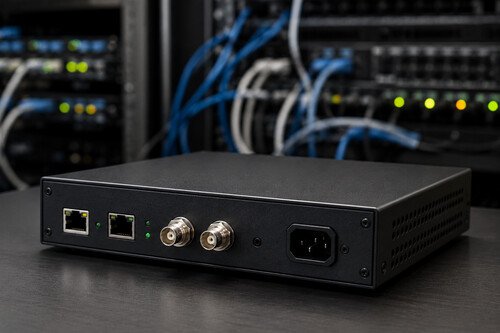
Modern broadcast and television distribution systems often combine traditional ASI-based equipment with IP network infrastructure. Many headends, cable TV systems, satellite installations, IPTV platforms, and broadcast facilities still use ASI interfaces, while newer systems increasingly rely on Ethernet networks to transport digital video streams. IP ASI gateways make it possible to connect these two technologies in one efficient workflow. An IP ASI gateway is a professional device that converts MPEG transport streams between IP and ASI formats. It can receive video streams over an Ethernet network and output them through an ASI interface, or convert an ASI signal into an IP stream for network-based distribution. This allows older broadcast equipment and modern IP systems to communicate without replacing the entire infrastructure. This article explains what IP ASI gateways are, how they work, where they are used, and why they are important in broadcast, IPTV, cable television, satellite, and headend environments. It also discusses their main advantages, limitations, and key technical factors to consider when choosing the right gateway for a professional video system.
What Are IP ASI Gateways?
IP ASI gateways are professional devices used to convert digital video transport streams between IP networks and ASI interfaces. They are commonly used in broadcast, cable television, satellite, IPTV, headend, and video distribution systems where content must move between traditional broadcast infrastructure and modern network-based systems.
The term “IP ASI gateway” usually refers to a device that can receive transport streams over an IP network and output them through an ASI port, or receive an ASI signal and convert it into IP streams. Some gateways work in only one direction, while others support bidirectional conversion. Their main purpose is to connect two different transmission environments: IP-based video delivery and ASI-based broadcast equipment.
ASI stands for Asynchronous Serial Interface. It is a professional digital interface widely used for carrying MPEG transport streams between broadcast devices. IP, or Internet Protocol, is used to transport digital data over Ethernet networks. An IP ASI gateway acts as a bridge between these two worlds, allowing older and newer systems to work together efficiently.
Understanding ASI Technology
ASI is a digital video interface designed to carry transport streams, especially MPEG transport streams, through coaxial cable. It has been widely used in professional broadcast systems because it is stable, predictable, and suitable for moving compressed digital video between devices.
In many broadcast and headend environments, ASI has been used to connect encoders, multiplexers, modulators, receivers, scramblers, analyzers, and other equipment. It is especially common in systems based on digital television distribution.
ASI does not usually carry uncompressed video like HDMI or SDI. Instead, it carries already compressed video and audio packaged inside a transport stream. This transport stream may include one television channel or multiple channels combined together.
Because ASI is a point-to-point interface, it is often used for direct equipment connections. For example, a satellite receiver may output a transport stream through ASI, which is then connected to a multiplexer or modulator. This type of workflow has been common in cable TV headends, broadcast stations, and distribution systems.
Understanding IP Video Transport
IP video transport works differently. Instead of sending the transport stream through a dedicated coaxial ASI connection, the stream is carried over an Ethernet network. This makes it possible to move video signals through switches, routers, fiber links, and wider data networks.
IP transport is flexible and scalable. A single network connection can carry many streams. Streams can be routed, duplicated, monitored, and distributed using standard network infrastructure. This is one reason why many modern broadcast and IPTV systems have moved toward IP-based workflows.
However, many existing systems still use ASI equipment. Replacing all ASI-based devices at once can be expensive and unnecessary. IP ASI gateways solve this problem by allowing IP streams and ASI equipment to operate together.
How an IP ASI Gateway Works
An IP ASI gateway receives a digital transport stream from one interface, processes it, and outputs it through another interface.
In an ASI to IP workflow, the device receives an ASI input through a coaxial connector. This input contains one or more MPEG transport streams. The gateway then encapsulates the stream into IP packets and sends it through an Ethernet port. The output may be configured as multicast or unicast, depending on the system requirements.
In an IP to ASI workflow, the gateway receives transport streams from an Ethernet network. It extracts the video transport stream from the IP packets and outputs it through an ASI port. This allows IP-originated content to be used by equipment that only accepts ASI input.
Some gateways support multiple inputs and outputs. For example, a device may have several ASI ports and one or more Ethernet ports. This allows several streams to be converted, routed, or distributed at the same time.
Why IP ASI Gateways Are Important
IP ASI gateways are important because they allow broadcast systems to transition gradually from traditional ASI infrastructure to IP-based transport. Many facilities have a mixture of old and new equipment. Some devices may only support ASI, while others are designed for IP streaming.
Without a gateway, these systems may not be able to communicate directly. An IP ASI gateway makes integration possible without replacing every device in the signal chain.
This is especially useful in headend systems, where signals from satellite receivers, encoders, multiplexers, and modulators may need to be combined and distributed. A gateway can convert ASI feeds into IP streams for transport across a network, or convert IP feeds back into ASI for use with traditional modulators or multiplexers.
The result is a more flexible system that can use existing infrastructure while also supporting modern IP workflows.
Common Applications of IP ASI Gateways
IP ASI gateways are used in many professional video systems. One of the most common applications is in digital TV headends. A headend may receive content from satellite, terrestrial, cable, or IP sources. Some of these sources may arrive as ASI streams, while others may arrive over IP. Gateways make it possible to combine these sources into one distribution system.
Cable television systems also use IP ASI gateways to transport digital channels between facilities. A group of channels may be converted from ASI to IP and sent over a fiber or Ethernet network to another location. At the receiving end, another gateway can convert the IP stream back to ASI for modulation or processing.
Broadcast facilities use these gateways to connect legacy equipment with IP-based routing systems. For example, an older encoder or receiver with ASI output can be connected to a modern IP distribution network through a gateway.
IPTV systems also benefit from IP ASI gateways. If a content source is only available through ASI, the gateway can convert it into an IP stream for IPTV delivery. This allows traditional broadcast feeds to be used in hotels, hospitals, campuses, residential systems, and commercial IPTV networks.
ASI to IP Conversion
ASI to IP conversion is useful when a transport stream from broadcast equipment needs to be distributed through a network. The gateway takes the ASI input and encapsulates the transport stream into IP packets.
This allows the stream to be sent over Ethernet infrastructure instead of using a dedicated ASI cable. Once the stream is on the IP network, it can be sent to multiple destinations, monitored remotely, or transported over longer distances using network links.
ASI to IP conversion is often used when centralizing video sources. For example, satellite receivers may be located in one equipment room, while processing or modulation equipment is located elsewhere. Rather than running many coaxial ASI cables, the signals can be converted to IP and transported over a managed network.
This approach can simplify cabling and improve flexibility, especially in larger facilities.
IP to ASI Conversion
IP to ASI conversion is used when a transport stream carried over a network must be delivered to traditional broadcast equipment. The gateway receives the IP stream, removes the IP encapsulation, and outputs the original transport stream through ASI.
This is useful when an IP source needs to feed a modulator, multiplexer, decoder, or other device that accepts only ASI input. It is also useful in systems where content is transported over IP between locations but processed using ASI equipment at the destination.
For example, a channel package may be sent from a central site to a regional headend over IP. At the regional site, the IP ASI gateway converts the stream into ASI so it can be inserted into the local television distribution system.
Multicast and Unicast Operation
IP ASI gateways often support both multicast and unicast streaming.
Multicast is commonly used in professional IPTV and broadcast networks. It allows one stream to be sent to many receivers without creating a separate stream for each destination. This is efficient when the same channel must be delivered to multiple devices.
Unicast sends a separate stream from one source to one destination. It is useful for direct point-to-point transport, testing, remote contribution, or systems where multicast is not available.
The choice between multicast and unicast depends on network design. In managed networks, multicast can be very efficient, but it requires proper switch configuration. If multicast is not configured correctly, the network may experience unnecessary traffic or unstable stream delivery.
Transport Stream Handling
An IP ASI gateway usually works with MPEG transport streams. A transport stream is a container format that can carry video, audio, subtitles, program information, and other data. It is widely used in digital television systems because it is suitable for continuous transmission.
The gateway must preserve the structure and timing of the transport stream. This is important because receiving equipment expects a stable and correctly formatted stream. If timing errors, packet loss, or jitter occur, the video may freeze, break up, or fail to decode.
Some gateways include features for packet buffering, jitter correction, stream filtering, and monitoring. These functions help maintain stable output even when the incoming network stream has minor timing variations.
Network Requirements
The performance of an IP ASI gateway depends heavily on the network. Video transport streams require stable bandwidth, low packet loss, and predictable timing. A poorly configured network can cause serious problems, even if the gateway itself is working correctly.
For multicast systems, switches should support multicast management. Without proper configuration, multicast streams may flood the network and affect unrelated devices. In professional installations, network traffic should be planned carefully.
Bandwidth is another important factor. Each transport stream uses a certain bitrate, and multiple streams can quickly consume network capacity. The network must have enough bandwidth not only for average traffic but also for peak conditions.
Quality of service settings may also be used to prioritize video traffic. This can help protect transport streams from interruptions caused by other network activity.
Signal Reliability and Monitoring
Reliability is critical in broadcast and television distribution systems. IP ASI gateways are often used in environments where video must run continuously for long periods.
Many gateways include monitoring tools that allow operators to check input status, output status, bitrate, packet errors, and stream presence. These tools help detect problems before viewers are affected.
Some systems also support redundancy. Redundant network inputs, backup streams, or automatic switching can improve reliability. If the primary stream fails, the gateway may switch to a backup source. This is important in professional systems where downtime must be minimized.
Advantages of IP ASI Gateways
One of the main advantages of IP ASI gateways is interoperability. They allow ASI-based equipment and IP-based systems to work together. This helps facilities modernize gradually instead of replacing all equipment at once.
Another advantage is flexibility. Once an ASI stream is converted to IP, it can be transported more easily across a network. It can be routed to different destinations, monitored remotely, or distributed over longer distances.
IP ASI gateways can also reduce cabling complexity. Instead of using many separate ASI coaxial cables, multiple streams can be carried through network infrastructure.
They are also useful for system expansion. A facility can add IP-based sources or destinations while continuing to use existing ASI devices.
Limitations and Challenges
Despite their benefits, IP ASI gateways have some limitations. The first challenge is network dependency. If the IP network is unstable, the video stream may suffer from packet loss, jitter, or interruptions.
Another challenge is configuration. IP addresses, ports, multicast groups, bitrate settings, and stream formats must be set correctly. Incorrect configuration can prevent the gateway from receiving or sending streams.
Compatibility is also important. The gateway must support the transport stream format, bitrate, and IP encapsulation method used by the system. Not every device supports every possible configuration.
Latency may also be introduced during conversion. In most broadcast transport applications, this delay is small, but it should still be considered in time-sensitive systems.
Choosing the Right IP ASI Gateway
When selecting an IP ASI gateway, the first factor to consider is direction. Some devices convert ASI to IP, some convert IP to ASI, and some support both. The correct choice depends on the signal flow.
The number of ports is also important. A small system may need only one ASI input or output, while a larger headend may require multiple ASI ports and several IP streams.
Supported bitrates should be checked carefully. The gateway must handle the required transport stream bitrate without errors. Network interface capacity is also important, especially when multiple streams are used.
Management features should also be considered. Web-based configuration, status monitoring, alarm reporting, and remote access can make operation much easier.
Finally, the gateway should match the reliability requirements of the installation. For critical systems, redundancy and monitoring features may be essential.
IP ASI gateways are essential tools for connecting traditional broadcast infrastructure with modern IP-based video networks. They convert transport streams between ASI and IP, allowing equipment with different interfaces to work together in one system.
They are widely used in headends, cable television networks, broadcast facilities, IPTV systems, satellite distribution, and professional video transport. Their main value lies in bridging old and new technologies, reducing cabling complexity, improving flexibility, and supporting gradual migration toward IP-based workflows.
A properly selected and configured IP ASI gateway can provide stable, efficient, and reliable transport stream conversion. However, successful operation requires attention to network quality, stream compatibility, bitrate, multicast configuration, ASI signal handling, and system monitoring.
In modern video distribution, where ASI and IP technologies often coexist, IP ASI gateways provide the practical connection that keeps both environments working together.